


How important is running for children’s development?
The Subotica Half Marathon is a sporting event that for years has brought together a record number of runners of all ages, and we in the organisation are certainly proudest of our youngest runners. Every year, as part of the half marathon, races over 100 and 300 metres are organised for children. Their smiles, happiness and satisfaction say what matters most: that we are doing the right thing, because from an early age we teach them the importance of physical activity.
Physical activity is extremely important for the proper development of children, especially today, when social networks, computers and content rule and make our youngest spend most of their time in front of screens, sitting. Through movement and participation in various sporting activities, children’s proper development is significantly encouraged, and it is precisely through running that they acquire and develop important physical and mental skills that will accompany them through life. It is important to know that through running the youngest strengthen their locomotor and cardiovascular systems, and running also affects the skeletal and muscular systems, which further encourages growth and development from an early age. Physical activity and running play an important role in developing strength, speed, endurance and flexibility, which can prevent various injuries in the long term, as well as obesity.
Besides the physical, running also has a positive effect on children’s cognitive development, because regular physical activity stimulates the development of new brain cells, while, for example, running outdoors in sunlight increases the number of brain cells according to the latest research. The so-called happiness hormones are released, which improves mood and concentration, and it is noticeable that children who are physically active concentrate better at school.
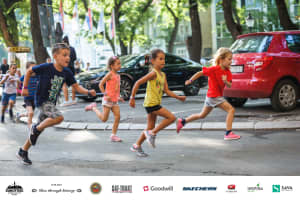
Running contributes to better self-confidence and interpersonal relationships, which also has a significant impact on the emotional aspect of the development of the youngest. From an early age running teaches them “fair play”, and the habits acquired at a young age are later mirrored in adulthood, so it is important to teach a child to value running and physical activity as a way of life and something normal, not something that is an obligation.
Is running good for children?
Although exercise is good for children, caution is still needed. If you want your little one to strike a balance between too much and too little exercise, simply follow these guidelines: careful running, training ideas, safe running exercises, the ultimate solution and how far children can go.
How much can a child train?
For children who are starting to run, it is important that it is enjoyable. The last thing you want is to dampen your child’s enthusiasm, and to make sure your child enjoys running, apply some of the following strategies: Make running fun for children. Instead of running countless kilometres, involve the child in games that involve running, as well as a small amount of exercise to build endurance. Go for speed training. Speed is certainly the hardest thing to improve, but if speed training is introduced to children while they are developing, the effects of the training are far greater than when you try to improve speed as an adult. Give them varied training. Avoid focusing on just one running discipline, and to ensure the child’s all-round development, let them take part in different running disciplines. Always make sure the child follows a protocol that includes warming up, cooling down and stretching. Technique matters in any activity, including running, and children will pick up good habits more easily than they will “unlearn” bad ones when they grow up. Include other activities too. Besides running, make sure you encourage your child’s overall development by exposing them to other activities that involve running, such as team sports. Letting a child race is fine, but it is important that the distance is short until they reach sufficient fitness and physical readiness. If your little one is under 15, read on for the recommended distance according to the child’s age.
Children under 4 – 50 m
5–6 years – 100 m
7–8 years – 200 m
9–10 years – 400 m
11–12 years – 800 m
12–13 years – 1.6 km
It is certainly best to consult a coach at an athletics club, or a professional, who with their knowledge and expertise will help your child show their qualities in running. Because healthy habits are acquired from an early age, and throughout life we only wisely build on them.